Geographical Overview of Birch Sap Collecting Region
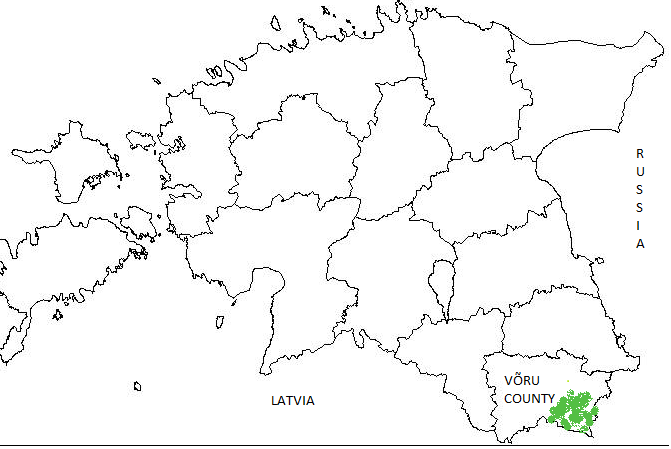
Võru County (look at the map below) is the most Southern county of Estonia, the only one bordering two different states - Latvian Republic (in the South) and Russian Federation (in the East). The territory of the county covers 2,305 km² and 33 426 people live here (population density 14,5 inhabitants/ km²), that is 2.5% of the total population in Estonia. The County centre is Võru town with 12 571 inhabitants. The county is subdivided into 12 rural municipalities (parish) and 1 urban municipality - Võru town.
Distances from Võru:
to Tallinn – 252 km (capital of Estonia, intl. airport, intl. ferry port),
to Riga – 225 km (capital of Latvia, intl. airport and port),
to St.Petersburg – 388 km (largest City in North-West of Russia, intl. airport, intl. ferry port),
to Pskov (Russia) – 100 km.
Võru county's main economic sectors are forestry and wood processing, furniture and food industry and also tourism. According to statistics of 2011, there are 1852 SMEs in Võru County. 47% of enterprises in the county belong to primary sector (agriculture, forestry), 38% of enterprises work in tertiary sector (trade, services) and 15% of enterprises are involved in secondary sector (processing industry). The biggest foreign owned companies based in Võru County are AS Toftan (wood processing), AS Barrus (wood processing), AS Antsla Inno (furniture production), AS Rauameister (metal processing), AS Võru Juust (food processing) and Danpower GmbH (energy production). Võru County`s focus is on green economy – local food and renewable energy – local people value their county for its pure nature, therefore they promote green economy, intelligent use of renewable energy and locally grown food.
Birch sap we are currently offering to you will be collected from 2 rural parishes in Võru County – Haanja parish and Misso parish (region is marked green on the map below). Both of these parishes, covered with forests are remote from any kind of industries or other sources of pollution. Population density in each parish is very low and in each one ecological purity and sustainability are subjects among the most important ones. Haanja Parish with an area of 170 km² is located in South-East of the county. Green – almost ½ of the parish is covered by forest – the first of all refers to rich nature of the parish. Over the ½ of the parish belongs to the Haanja Nature Park. Biological diversity and synergistic influence of different landscape components provide the basis for uniqueness and beauty of nature of the parish.
Misso Parish with an area of ~188 km2 is also located in South-East of the county and is neighboring parish to the Haanja. Misso is the most remote parish of the region, adjacent to the South with Latvia and to the East with Russia and to the extent of 63,5% covered with forests. Population density is 3,7 inhabitant/km2. The major part of the parish is part of Haanja-Karula Recreation Area.
Information about exact birch sap collecting territories (by the December 2015) could be acquired on web-page of Estonian Land Board http://geoportaal.maaamet.ee/eng/ using following link
http://xgis.maaamet.ee/xGIS/XGis?app_id=UU82&bbox=311427.203065134,6375000,793572.796934866,6635000&LANG=2 where anyone can do inquiries by using following cadaster ID-s: 1. Misso Parish: 46801:004:0038, 46801:003:1172, 46801:003:1171, 46801:001:0186, 46801:001:0100, 46801:003:1832, 46801:003:1833, 46801:003:0750, 46801:003:0760 2. Haanja Parish: 18101:002:0450, 18101:002:1080
Geographical Overview of Birch Sap Collecting Region
Informational source:
http://www.vaa.ee/facts-about-voru-county
https://voru.maavalitsus.ee/web/eng
http://www.haanja.ee/about-parish/
http://www.misso.ee/